Showing posts with label Seeds and Seedlings. Show all posts

Sunday, April 1, 2012

Winter to Spring

I think I've finally gotten over the hump that is winter. Not that I haven't enjoyed it, winter that is. Our yurt trips were great this year.


Lots of beautiful snow.


But now.........it's time to plan for summer.

Kim is way ahead of me in that department.

He has his tomatoes going strong.


And in the cold frame he's planted radishes, carrots, lettuce and chard.


In the veg garden Kim has broccoli, onions, peas and more lettuce planted.

He even planted two baskets with pansies I bought. (To be fair, I was working in the garden at the time.)


I finally managed to plant some vine seeds yesterday. I've been very remiss with my flower seeds this year. Oh well. It does feel good now to have something to anticipate. Those castor beans and vines provide nearly instant gratification the way they germinate so quickly into big seedlings. So I'm looking forward to that.

Felix has been enjoying the garden. Here he is inspecting my new garden path.


And proof that spring is here;


I'm also excited because we have three new chicks on order. I'll be posting pictures of them in a couple of weeks. In the meantime check out Catherine's little beauties.

Tuesday, March 8, 2011

Seedlings Again

Where is Spring???

It's snowing as I type this; right outside my window with no respect for my feelings at all.

Anyway.....Kim saved tomato seeds last fall. His method;

1. Scoop seeds out of your tomato.
2. Cover with water for 2 weeks as the gelatin around the seeds ferment and break down.
3. Rinse in colander and dry.

This site has all the details also.


The saved, fermenting seeds:


And, his seedlings:


I managed to sow some flower/veggie seeds last week. Some have germinated already. I think I'll play around with some more seeds today and pretend it's as good as playing outside in the garden.

Sunday, April 11, 2010

Meet Our Coldframe


And I call it our coldframe because it's not heated, so to me it's not a greenhouse.

But it works for our purposes.

Kim started lettuce, radishes and carrots in there a few months ago.


I'm hoping we can get more use out of it by installing some beds and growing some cold crops during the fall/winter season. That's my plan anyway, we'll see what happens.


Our biggest use for it now is for our seedlings. The tomatoes love the heat and sun it provides.


Kim installed an auto vent so the window will open when it heats up too much during the day. At night when the temp falls too low we haul all the tender plants into the house.


My various seedlings are doing pretty well this year. I'm happy with them.


The Empress clematis I bought earlier this year has already bloomed in the coldframe. Love that flower.


And thanks to whichever blogger it was that suggested overwintering geraniums. Two of mine from last year have sprouted and are looking great.

Friday, February 26, 2010

It's That Time of Year Again...

......time to get those seeds going.

Kim actually started weeks ago by planting radishes, lettuce and onions in containers in the cold frame. Everything is up but the onions.


Here's a preview of annuals I planted for our front containers.

(not my pictures.....my plants aren't plants yet.)


Notice a pattern?

Last year when Mary Ann visited our garden she gave us the lovely book Container Gardening Through the Year by Malcolm Hillier. Reading that book has inspired me to attempt to limit myself to one color pallet this year.

From the book:

"Color is very much a matter of personal taste, but when planning designs for containers, an awareness of the mood color combinations create is important....red, orange, and yellow evoke a feeling of 'warmth'......warm colors are those the mind associates with the sun and a sense of well-being...."

Oh yeah, I like that.....a sense of warmth and well being.

Usually my front containers are willy-nilly and whatever I happen to like/have on hand.

Not sure what mood has been evoked from my past efforts; perhaps confused, bordering on psychotic.

I'll let you know how this idea turns out.

Are you trying anything new in gardening this year?

Friday, June 19, 2009

Small Success

I'm so happy! I started these little impatiens, 'Tempo Apricot', from seed this year and they're finally blooming.
I know for a lot of gardeners growing impatiens from seed is easy, but not for me. I've tried them before without any luck. I'm glad I tried again this year.

They're small but they're cute and they look nice in the shade garden.

Next year I'll try growing fuschias from seed.
Again.


This week I also had my first petunias bloom from seed.

Note to self: start seeds earlier next year.
(I knew that already but I allow the annual yurt trip to interrupt my seed starting.)


Monday, May 4, 2009

The Tomato Traitor

Yeah, that would be Kim!

Leave him alone for a day with a bit of money and look what he does.

We have perfectly good tomato plants, started from seeds, with my own two precious hands.


They look alright, right?

Right???

OK, maybe they're a bit small. OK, maybe really small. Really, really small.
But I have faith in them. I believe with all my heart they will grow up to be big happy tomato plants. And that they will yield glorious tomatoes that will make us perfectly happy.

Here is what was waiting in the plant room when I got off work today.


That's right. Tomatoes from THE TOMATO TRAITOR as he shall now be named!

Here they are showing off to my little tomatoes.


I ask you, is that fair?

And I'll tell you, no it ISN'T!

But, I will prevail with my little tomatoes. I am determined to do so.

Some tomato growing info from About.Dom, Gardening:

1. Don’t Crowd Seedlings.
Don't Let Seedlings Grow Into Each Other. If you are starting tomatoes from seed, be sure to give the seedlings room to branch out. Close conditions inhibit their growth, so transplant them as soon as they get their first true leaves and move them into 4" pots about 2 weeks after that.

2. Provide lots of light.
Tomato seedlings will need either strong, direct sunlight or 14-18 hours under grow lights. Place the young plants only a couple of inches from florescent grow lights. Plant your tomatoes outside in the sunniest part of your vegetable plot.

3. Put a fan on your seedlings.
It seems tomato plants need to move and sway in the breeze, to develop strong stems. Provide a breeze by turning a fan on them for 5-10 minutes twice a day.

4. Preheat the soil in your garden.
Tomatoes love heat. Cover the planting area with black or red plastic a couple of weeks before you intend to plant. Those extra degrees of warmth will translate into earlier tomatoes.

5. Bury them.
Bury tomato plants deeper than they come in the pot, all the way up to a few top leaves. Tomatoes are able to develop roots all along their stems. You can either dig a deeper hole or simply dig a shallow tunnel and lay the plant sideways. It will straighten up and grow toward the sun. Be careful not to drive your pole or cage into the stem.

6. Mulch Later.
Straw Makes a Great Vegetable Garden Mulch. Mulch after the ground has had a chance to warm up. Mulching does conserve water and prevents the soil and soil born diseases from splashing up on the plants, but if you put it down too early it will also shade and therefore cool the soil. Try using plastic mulch for heat lovers like tomatoes and peppers.

7. Remove the Bottom Leaves.
Once the tomato plants are about 3' tall, remove the leaves from the bottom 1' of stem. These are usually the first leaves to develop fungus problems. They get the least amount of sun and soil born pathogens can be unintentionally splashed up onto them. Spraying weekly with compost tea also seems to be effective at warding off fungus diseases.

8. Pinch & Prune for More Tomatoes
Pinch and remove suckers that develop in the crotch joint of two branches. They won’t bear fruit and will take energy away from the rest of the plant. But go easy on pruning the rest of the plant. You can thin leaves to allow the sun to reach the ripening fruit, but it’s the leaves that are photosynthesizing and creating the sugars that give flavor to your tomatoes.

9. Water the Tomato Plants Regularly.
Water deeply and regularly while the plants are developing. Irregular watering, (missing a week and trying to make up for it), leads to blossom end rot and cracking. Once the fruit begins to ripen, lessening the water will coax the plant into concentrating its sugars. Don’t withhold water so much that the plants wilt and become stressed or they will drop their blossoms and possibly their fruit.

10. Getting Them to Set Tomatoes.
Determinate* type tomatoes tend to set and ripen their fruit all at one time, making a large quantity available when you’re ready to make sauce. You can get indeterminate* type tomatoes to set fruit earlier by pinching off the tips of the main stems in early summer.

From ivillage GardenWeb:

*Determinate varieties of tomatoes, also called "bush" tomatoes, are varieties that are bred to grow to a compact height (approx. 4 feet). They stop growing when fruit sets on the terminal or top bud, ripen all their crop at or near the same time (usually over a 2 week period), and then die.
They may require a limited amount of caging and/or staking for support, should NOT be pruned or "suckered" as it severely reduces the crop, and will perform relatively well in a container (minimum size of 5-6 gallon). Examples are: Rutgers, Roma, Celebrity (called a semi-determinate by some), and Marglobe.


*Indeterminate varieties of tomatoes are also called "vining" tomatoes. They will grow and produce fruit until killed by frost and can reach heights of up to 10 feet although 6 feet is considered the norm. They will bloom, set new fruit and ripen fruit all at the same time throughout the growing season. They require substantial caging and/or staking for support and pruning and the removal of suckers is practiced by many but is not mandatory. The need for it and advisability of doing it varies from region to region. Experiment and see which works best for you. Because of the need for substantial support and the size of the plants, indeterminate varieties are not usually recommended as container plants. Examples are: Big Boy, Beef Master, most "cherry" types, Early Girl, most heirloom varieties, etc.


An explanation of catfacing and why it's important to keep your tomato plants warm:

Insect damage, poor pollination, and environmental factors all cause catfacing, a term that describes the puckering, scarring, and deformation of strawberries, stone fruits, and tomatoes. You can recognize catfacing in tomatoes by the scarred indentations found on the blossom end of the fruit. Sometimes this scarring extends deep into the fruit cavity, making much of the fruit inedible.

The most common cause of catfacing in tomatoes is exposure to temperatures below 50 degrees F during flowering and fruit set. Low temperatures inhibit pollination and cause the blossom to stick to the developing fruit. Both of these factors prevent certain parts of the fruit from developing. The undesirable scarring and indentation occurs when unaffected parts of the fruit continue to expand.

Tomatoes that develop during warm weather do not usually experience catfacing problems. However, evidence suggests that even when temperatures are warm, excessive soil nitrogen, exposure to the pesticide 2,4-D, and erratic soil moisture can cause catfacing.

Some cultivars and varieties, including many heirlooms, are more susceptible to catfacing. You can avoid the problem by choosing resistant varieties, such as 'Homestead' and 'Monte Carlo'. If your favorite varieties are susceptible but you'd still like to grow them, either protect your transplants with cloches in cold weather or wait until day and evening temperatures are consistently warm to plant them.

Catfaced tomatoes are safe to eat; simply cut away the scarred areas.


I shall follow this advice and raise magnificent tomatoes!!!

I hope.

Thursday, April 23, 2009

Seedling Update

Well, I don't know. They're growing. Just doesn't seem as if they're doing their best, if you know what I mean.

Here are the Mountain Garland, the seeds were a gift from Connie.


They're doing very well. Tall, strong.
They should look like this when blooming.


And the description: "A delightful annual flower, native to California, which is easily grown throughout the United States. This species of Clarkia is often confused with Rocket Larkspur at first glance. Compact blossoms are arranged on spikes in soft pastel shades of pink to salmon or purplish hues. The tall stems are deep purple in color making identification easy prior to flowering. Prefers full sun but will grown in partial shade. Can tolerate a wide range of environmental conditions but avoid heavy clay soils. You will be tickled pastel!!!"
(I think I will be tickled with them.)


The Love Lies Bleeding (Amaranthus cauditis) are doing well. I may try to pinch some of them back and use them in a hanging basket this year. I've read about people doing that and I think that could look great if it works.


I can tell they look very tall in this shot. They're actually just a couple of inches so far.


Eventually they'll look like this. If all goes well.


The salvias and foxgloves are coming along. Just seems as if they should be bigger, you know what I mean? The salvia germinated mid-March, the foxglove early March.


And speaking of doing poorly. My little tomatoes are just that, little.
I won't give up on them. Patsi sent me the seeds. Hers were lovely last year. If only I could do her justice.


I probably just didn't get them started early enough. They germinated mid-March.
We keep the tender annuals indoors under lights unless the weather is nice, then they get transported to the coldframe for some nice heat and sunshine. I never let them feel anything less than 50˚ temps.


I planted all my vines, cosmos and zinnias a week ago.
This Cardinal Climber from Patsi is coming on strong.


I think it was Patsi who also sent me some Hyacinth Bean vine, which I hadn't grown in a while. Since Kim is in the process of building a replacement for my old willow arch I decided I would need some new fast growing vines for it. Of course it will have plenty of morning glory vines (Ipomoea) as well.


And Connie also sent me these sunflower Ruby Eclipse seeds.


They look dark and beautiful already.
Eventually.....


Are you growing plants from seed?
How are yours doing?

Tuesday, March 10, 2009

Better Late Than Never

I finally got around to planting some seeds - even if it is March already. Felt great to work in the soil. This year we bought Black Gold seedling mix. I like this product and have great expectations for my seedlings.

It's wonderful to have a spare bedroom to lay out trays for the seedlings and lights.


I'm about a month behind in my normal planting schedule, but that just means less transplanting later, right? (At least that's how I'm comforting myself.)

Here are the geraniums,


and salvia with lobelia and foxglove in the background,


THE LIST:

1. impatiens
2. petunia - salmon velvet, prism sunshine, cascade pink, super basket, pearls azure blue, vining, pink lady
3. coleus
4. geranium border scarlet
5. fuchsia
6. lady's mantle
7. dusty miller
8. lupin 'sundown', blue bonnet
9. lobelia - blue cascade, paper moon, cascading mix
10. salvia - mix, phoenix bright lilac
11. foxglove - white, candy mountain, excelsior mix
12. nicotiana - perfume deep purple, eau de cologne mix, fragrant cloud
13. cerinthe
14. nepeta
15. astrantia
16. phacelia - lavender, tropical surf
17. Amaranthus - love lies bleeding, joseph's coat
18. basil - green and purple
19. snapdragon - black prince, rembrandt
20. scabiosa - ace of spades
21. brussels sprout
22. Hot Tepin Peppers

and seeds from Connie -

Laura Bush Petunia
German Catchfly
Corn Cockle
Dairy Pink
Mountain Garland
Feverfew

And not forgetting some tomatoes; courtesy of Patsi -

Trucker's Favorite
Woodrow
Red Star
Amish Red
Tiger Tom
Purple
Spartan Pink

So satisfying to watch the babies grow.

What have you planted lately?

Wednesday, April 30, 2008

More spring........

There is so much going on in the garden. April has been chilly and DRY (0.22 inches of precip).....so we've already needed to water the garden twice. Not nice for April.


Garden highlights..


The giant alliums are getting ready to do their thing. Great, reliable plants. And they multiply like tulips. I love 'em.


The daffodils are just about finished...
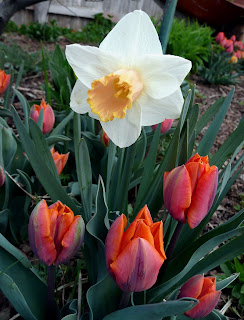


I don't know where this tulip came from, (I don't remember planting it) but it is pretty.


The tulips in the back garden are all in bloom except for the yellow ones. This photo shows the garden as you step into it from our back porch. (From the left side).


For the most part Chelsea has been behaving herself in the garden. Meaning she hasn't been running through the beds too much. (Except when she feels the need to chase squirrels.)


More tulips in the back garden.


The serviceberry tree has bloomed and now is finished.


The basket of gold is doing it's thing.


I forgot that I planted these Odalisque tulips under the dogwood tree. Could use about twice the amount. (Next year)


The dogwood will be blooming soon. It happily lives in the shade of the Locust 'Sunburst' tree in the background.


The primroses are starting to bloom.


This little guy, or gal, seems pleased to have overwintered in the pond.


So, on to the front garden. Right now it's all about tulips and phlox.


Kim shot the following photos. His perspective is very different from mine and I enjoy it.
(He has the advantage. He attended photography school.)


And for our Portfolio eating plan......it's going OK. We're eating a lot of this type of food...


I had a doctor appointment this weekend. My cholesterol is currently 219. Not great. She's giving me three months to bring it down to 200. Can I do it? I hope so. I was on Lipitor a few years ago for my high cholesterol. But they can't locate my cholesterol count from back then and I don't remember what it was. How have I been doing on my new food plan? Well, not bad. But, I have succumbed to the occasional cookie while at work. Now, no more of that. I really want to avoid the prescription meds.
I baked these cookies today.


Not bad tasting. I substituted half whole wheat flour and added chocolate chips to make them more appealing to me. I'm hoping they'll keep me from giving into temptation at work.

And finally; a short wine review.


The winner; definitely the wine in the center; Chateau Douley. (It was the most expensive at $16. But, you usually get what you pay for.) The Timberwood was $5.

The Italian Monetepulciano at $10, was OK. The Timberwood I can't recommend at all. For anything.


Also, I planted more seeds today; this will be my final planting for this spring.

Datura
Mexican sunflower (tithonia)
Sonata white cosmos
Lemon gem marigold
Red Brocade marigold
Giant yellow marigold
Moonflower
Thunbergia (salmon)
Canary creeper
Heavenly Blue morning glory
Kniola's Black Knight morning glory
Scarlet O'Hara morning glory
Teddy Bear sunflower
Nasturtium nanum empress of India
Zinnia Elegans
Crimson Rambler morning glory
Red rock penstemon
Cypress vine
Sunspot morning glory
Love in a Puff vine
Zinnias
more marigolds
Purple millet

My "plant room" setup:


Yeah, it's a little late. I'm behind on my plantings. But better late than never, right?

Our cat, Ebby, hanging out in the "plant room". I'm just grateful she hasn't attacked the catmint seedlings.